
Education and Training Series #116: A temperature-based approach to estimate decay heat in SFRs and validate associated computational tools
This webinar is part of a series hosted by the GIF Education and Training Working Group since 2016.
The link to register to this webinar can be found on this page under "about this webinar".
Who should attend?
Policymakers, industry professionals, regulators, researchers, students, the general public.
About the "GIF Education and Training" Webinars
These webinars, organised by the GIF Education and Training Working Group are streamed live monthly. The recordings and slide decks are accessible after the webinar on this website. These webinars cover a very broad range of technical and policy related topics. Since 2016 and as of 2026 they have been viewed by more than 20000 people (approximately half of the views during the live streams and the other half views being of the archives on the public GIF website). In total, the GIF webinars have reached Generation IV enthusiasts, scientists, engineers and policy makers in more than 90 countries.
These webinars are organised and hosted by the GIF Education and Training Working Group (ETWG).
About this Webinar
The fission process in nuclear reactors generates radioactive byproducts, with decay heat persisting post-shutdown and crucial for safety. Scientific Calculation Tools (SCT) estimate decay heat but require validation through experiments, which are scarce, especially for MOX fuels in Pressurized Water Reactors. Decay heat measurements on Phénix and Superphénix reactors offers insights but have discrepancies. This webinar will present how identifying biases and uncertainties helped achieve consistency between SCT calculations and Phénix experiments. It also explores the potential applicability of these findings to MOX fuels in PWRs, yielding encouraging results.
Dr. Patricia Paviet from PNNL, USA, member of GIF ETWG will facilitate this webinar. The GIF ETWG webinar series started in 2016 and more than 100 webinars have been streamed since then. People from more than 80 countries have attended these webinars over the years. You can learn more about previous webinars and ETWG activities on the GIF website.
Meet the presenter and moderator
Dr
Dorian DA CUNHA
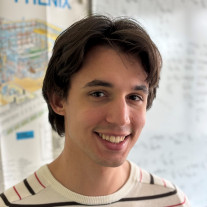
Dr. Dorian Da Cunha is a Research Engineer at CEA, in Cadarache, France. He recently graduated from Aix-Marseille University. He was involved in the design of chain-reaction control devices for Molten-Salt Reactors. His Ph.D. research focused on the interpretation and analysis of decay heat measurements in sodium-cooled fast neutron reactors. He developed new methodologies for interpreting these experiments and comparing them to computed values to validate Scientific Computation Tools. He now works on optimizing the estimation of the quantities of interests for the fuel cycle of PWR, including decay heat.
Dorian was the Popular Vote winner of the 2025 edition of the GIF "Pitch your Gen. IV Research Competition".

Dr
Patricia PAVIET
Dr. Patricia Paviet was the first chair of the GIF Education and Training Working Group (2015-2024). She now focuses on leading the efforts of the successful GIF Education and Training webinars series and has been doing so since the inception of this initiative in September 2016.
She serves on the GIF MSR pSSC representing the United States since 2021. She joined GIF in November 2015, as chair of the Education and Training Task Force. Outside GIF, Dr. Paviet is the National Technical Director of the Molten Salt Reactor Program for the US Department of Energy, Office of Nuclear Energy. She is managing the research supporting molten salt reactor development across six U.S. national laboratories. She is also a Senior Technical Advisor at Pacific Northwest National Laboratory, providing guidance on used nuclear fuel recycling. She has an extensive technical background on the nuclear fuel cycle (front and back end).